
If you’re shopping for the 5 best air purifiers for a baby sleep room in 2026, you’ll want models that combine true HEPA filtration, activated carbon, and multi-stage systems with real-time PM2.5 alerts. Think about quiet operation, dimmed displays, auto shut-off, and child-safety features, plus room-fit up to 300 ft² and solid CADR. Each option has trade-offs, so you’ll want to weigh maintenance indicators and safety features to decide which one truly fits your nursery vibe—and what comes next might surprise you.
Key Points
- Prioritize true HEPA filtration (H13) plus activated carbon for odors/VOC control in nurseries, with models offering 99.97% efficiency at 0.3 microns.
- Choose compact units with verified room coverage (up to 300 sq ft for Stella or 470 sq ft CADR for large rooms) and adjustable ACH options.
- Favor ultra-quiet sleep modes (21 dB or below) with dimmed indicators and optional white noise for baby-friendly operation.
- Look for real-time PM2.5 monitoring, smart alerts, sleep-safe lighting, and app control for parent-friendly monitoring.
- Ensure safety and certifications (CARB, ETL/Energy Star) plus maintenance indicators and 2,500-hour/3–4 month filter reminders.
InvisiClean Stella: Portable HEPA Air Purifier with UV Ionizer
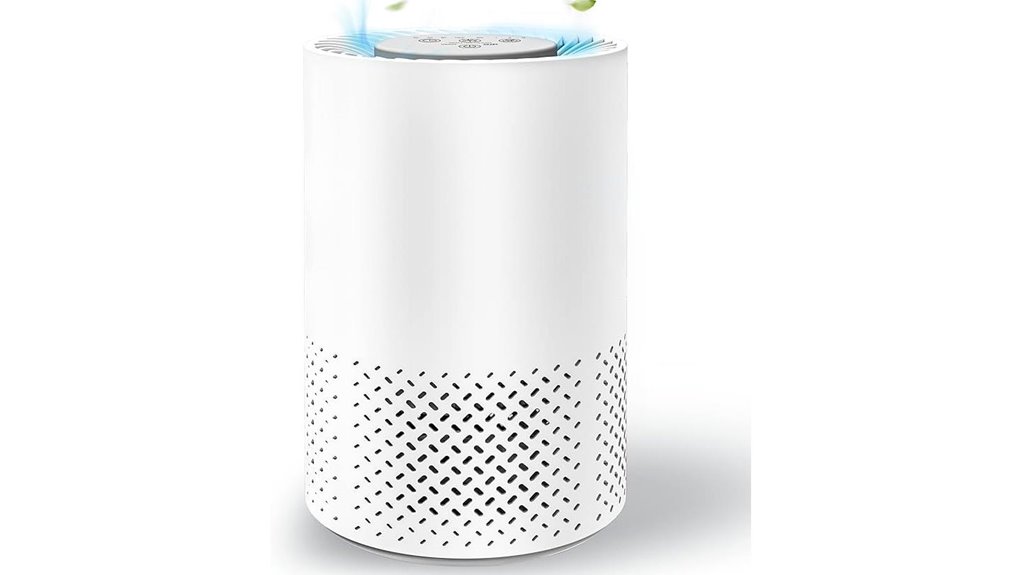
The InvisiClean Stella is a portable, desk-sized HEPA purifier with an optional UV-C light and ionizer—making it a strong pick for baby sleep rooms up to 300 sq ft. You’ll enjoy easy placement in bedrooms, nurseries, or home offices, thanks to a compact design. It uses replaceable H13 filters (99.98% true HEPA) plus activated carbon pre-filters, and can add a UV-C light or ionizer for enhanced filtration. Coverage ranges up to 300 sq ft at 1 ACH, or 75 sq ft at 4 ACH. It’s quiet, with multiple speeds, CARB-approved, SGS-tested, and backed by US-based support.
Best For: Those seeking a compact, desk-friendly air purifier for bedrooms, nurseries, or small home offices that can operate with optional UV-C and ionizer features.
Pros:
- Compact, lightweight design ideal for desks and small spaces
- Replaceable H13 true HEPA filter (99.98%) with activated carbon pre-filters
- Optional UV-C light and ionizer to enhance filtration; CARB-approved and SGS-tested
Cons:
- Covers up to 300 sq ft at 1 ACH or 75 sq ft at 4 ACH, which may be limiting for larger rooms
- 110V power requirement restricts portability to outlets; no battery option
- Optional features (UV-C/ionizer) may add cost and require maintenance/spare parts
Air Purifier for Bedroom with Sleep Mode HY1800 White
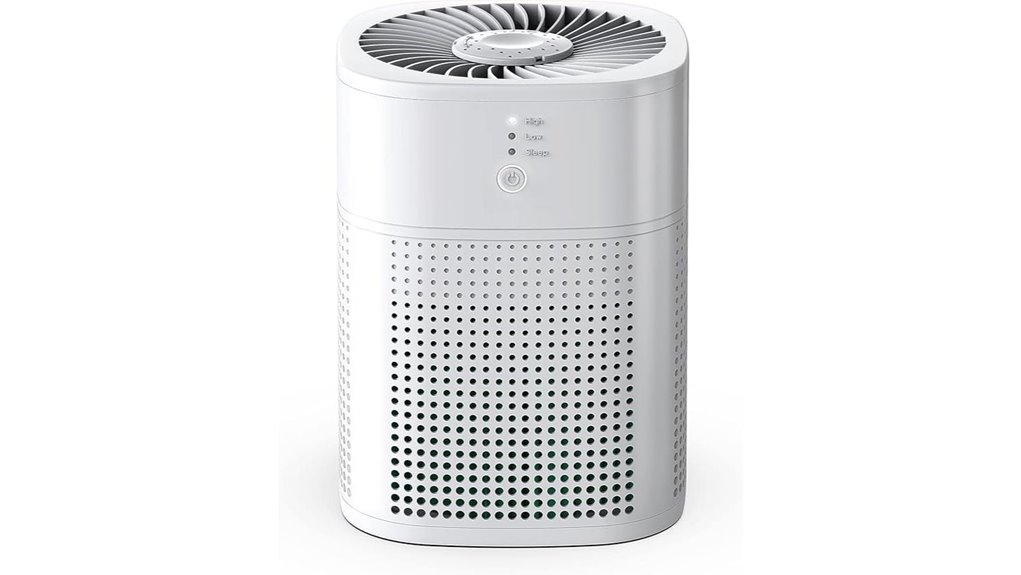
Looking for a compact purifier that won’t wake you up? The HY1800 White bedroom purifier uses a 3-stage filtration—H13 True HEPA, pre-filter, and activated carbon—to capture 99.97% of particles as small as 0.3 microns. With 360-degree air intake, it cleans every corner in rooms up to 108 square feet. A built-in scent pad lets you add essential oil for a calming diffuser effect. Choose Sleep mode for ultra-quiet operation, plus a 4-hour timer for automatic shut-off. Simple one-button control covers low, high, and standby, making it practical for bedrooms, dorms, or small living spaces. Ideal as a thoughtful gift.
Best For: those seeking a compact, quiet, and easy-to-use purifier for bedrooms, dorms, or small living spaces with optional essential-oil scent diffusion.
Pros:
- 3-stage filtration (H13 True HEPA, pre-filter, activated carbon) captures 99.97% of 0.3 micron particles.
- 360-degree intake and compact design fit small rooms up to 108 sq ft; ultra-quiet Sleep mode.
- Built-in scent pad allows optional essential oil diffusion for a calming environment.
Cons:
- Scent diffusion requires adding your own essential oils (not included), and may not suit sensitive users.
- Limited coverage to about 108 square feet; larger rooms may need a bigger unit.
- Basic one-button controls with a few modes may feel restrictive for users needing more customization.
Medify MA-14 True HEPA Air Purifier for Rooms
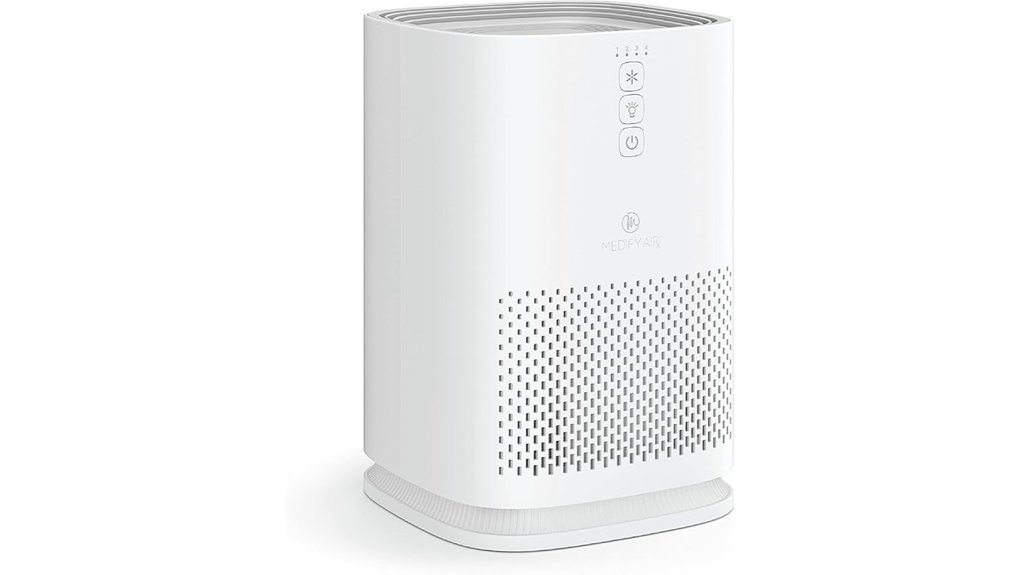
If you’re shopping for a room that’s sensitive to noise, the Medify MA-14 stands out with ultra-quiet operation and a sleep mode that dims the panel lights, making it a solid pick for baby nurseries and bedrooms where peaceful sleep is a top priority. It cleans spaces up to 470 sq ft per hour (CADR 120), suitable for homes, bedrooms, kids’ rooms, and offices. With TRUE HEPA H13 filtration, it captures 99.9% of particles to 0.1 microns, targeting allergens, odors, VOCs, smoke, and pollen. Three fan speeds, near-silent at low, and a 360-degree filter indicator keep maintenance simple. Lifetime USA warranty included.
Best For: Homeowners or caregivers seeking a quiet, effective air purifier for bedrooms, nurseries, or living spaces up to 470 sq ft with true HEPA filtration and minimal maintenance.
Pros:
- Ultra-quiet operation with a near-silent low setting and sleep mode
- True HEPA H13 filtration capturing 99.9% of particles to 0.1 microns
- Large coverage (up to 470 sq ft per hour) and simple maintenance with a 360-degree filter indicator
Cons:
- Maximum noise can reach up to 55 dB at highest speed
- Replacement filter (B07VF25QJ6) required every ~2,500 hours or 3–4 months
- 110-volt operation may limit use in regions with different electrical standards without adapters/upgrades
Baby Air Purifier with Safe-Sleep Design and HEPA Filtration
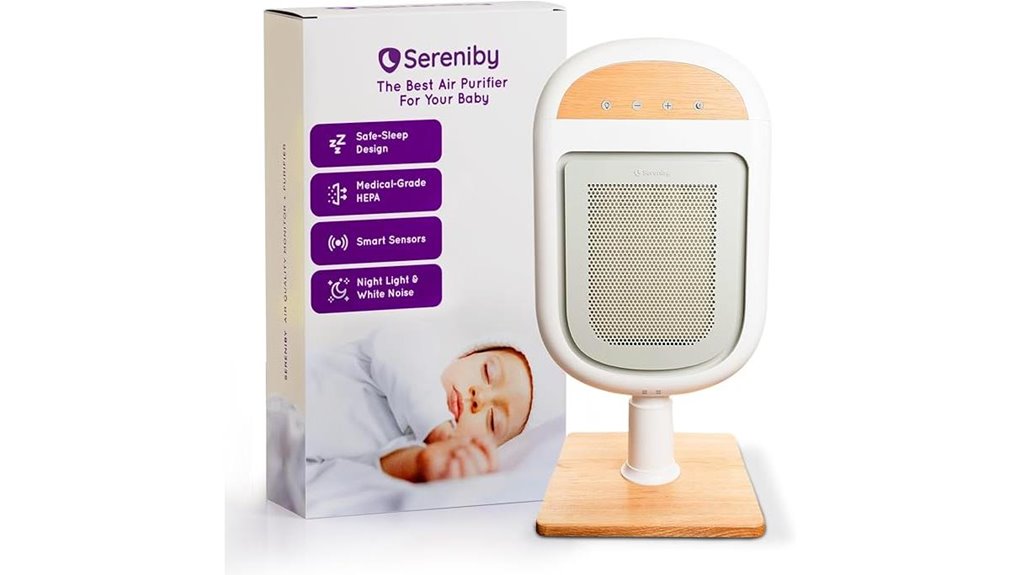
For parents prioritizing safety and quiet, this Baby Air Purifier with Safe-Sleep Design and HEPA Filtration stands out as the best choice, because it combines sleep-friendly features with medical-grade filtration. You’ll get Safe Sleep Design that gently circulates clean air across your baby’s breathing zone, sweeps away CO₂ and pollutants, and uses built-in white noise plus subtle red sleep lighting to support deeper rest without disrupting rhythms. It features tip-over protection, no exposed fans, hidden cords, and a modern Sereniby look. Filtration is medical-grade HEPA, removing viruses, wildfire smoke, allergens, and more with up to 5x effectiveness. Real-time sensing, smart alerts, and a parent app complete the package.
Best For: Parents seeking a sleep-focused, medical-grade air purifier that protects baby through quiet, safe design and real-time monitoring.
Pros:
- Safe Sleep Design with gentle air circulation, CO₂/ pollutant removal, and built-in white noise plus subtle red sleep lighting to support restful sleep
- Medical-grade HEPA filtration up to 5x more effective against viruses, wildfire smoke, pollutants, and allergens
- Comprehensive sensing and smart features with real-time air quality monitoring, temperature monitoring, WHO/AAP-guided alerts, and a parent app
Cons:
- Higher upfront cost reflects advanced features and filtration
- Requires regular filter maintenance and potential app reliance for full functionality
- Larger nursery footprint due to integrated design and safety features
Momcozy 4-in-1 Air Purifier for Bedroom, Night Light
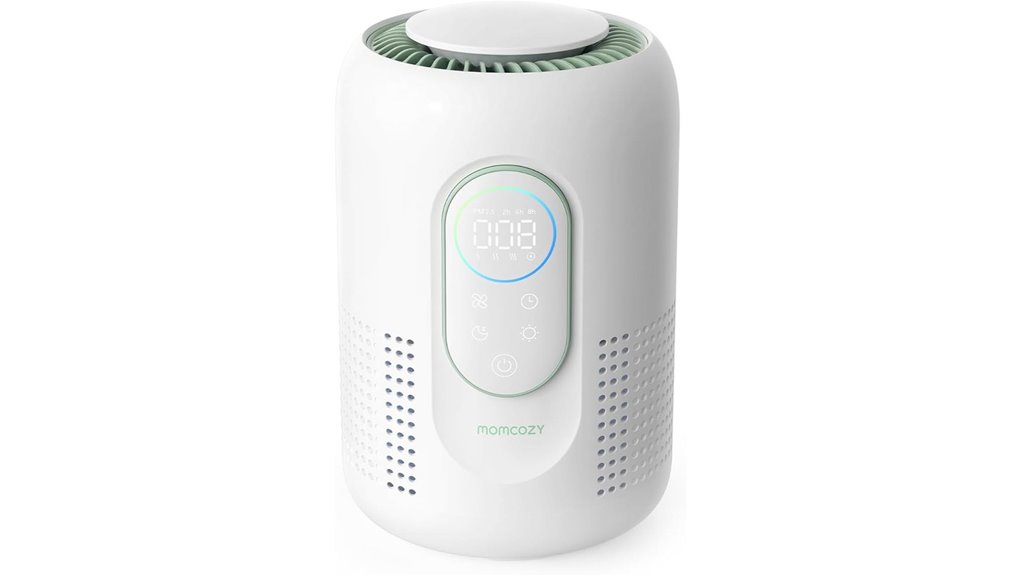
The Momcozy 4-in-1 Air Purifier for Bedroom, Night Light stands out for parents who want a compact, all-in-one solution that combines air cleaning with a gentle night light. You’ll get a quad-layer filtration that captures fine particles, pet dander, and odors, plus a silver ion finish for extra care. Real-time PM2.5 monitoring makes it easy to track air quality at a glance. In ultra-quiet sleep mode, it runs around 21 dB, so nights stay peaceful. Its compact footprint fits a nightstand, and Smart Auto Mode adjusts power based on readings to keep nursery calm. It’s sized for 250 sq ft spaces.
Best For: Parents seeking a compact, quiet, all-in-one air purifier with a night light for a small nursery up to 250 sq ft.
Pros:
- Quad-layer filtration captures fine particles, pet dander, and odors while adding a protective/silver ion layer for extra care.
- Real-time PM2.5 monitoring with a three-color status ring makes air quality easy to read at a glance.
- Ultra-quiet sleep mode at ~21 dB and dimmable night light create a calm, baby-friendly nighttime environment.
Cons:
- Coverage is stated for 250 sq ft, which may be insufficient for larger rooms or open-plan spaces.
- May require proximity to bed on a nightstand to optimize lighting and sensor readings.
- Auto mode adjusts fan speed based on PM2.5, which could lead to noticeable changes in airflow for very sensitive sleepers or during brief air-quality spikes.
Factors to Consider When Choosing Air Purifier for Baby Sleep Room
When choosing an air purifier for your baby’s sleep room, start by matching the filter type and purity to your needs and ensuring the unit fits the room size you have. Consider how you’ll handle noise, preferred sleep-mode benefits, and the device’s safety certifications to keep evenings calm and safe. Finally, check room size compatibility and any extra features that support quiet operation and overall peace of mind.
Filter Type And Purity
Choosing the right filter type is key for a baby sleep room: opt for true HEPA filtration (H13) to capture at least 99.97% of particles as small as 0.3 microns, reducing dust, pollen, and pet dander. You’ll get added value from pre-filters and activated carbon filters that catch larger particles and VOCs, extending the main HEPA’s life and enhancing odor removal. Some models use medical-grade or high-efficiency filters designed for nurseries or neonatal care, offering extra reassurance for sensitive environments. Look for replacement filter indicators and clear maintenance intervals, typically around 2,500 hours or 3–4 months, to keep air consistently purified for baby sleep. Additional features like anti-odor layers, quiet operation, and real-time air quality monitoring help sustain a calm, sleep-friendly room.
Room Size Compatibility
Is your baby’s nursery large enough to warrant a purifier, or should you aim for something a bit more compact? Start with room size in mind. Choose an air purifier with a recommended coverage that matches or exceeds the baby’s room, ideally units rated for 250–470+ sq ft, to guarantee effective air changes. Check the CADR and pick a model whose rate fits the space, since higher CADR means faster filtration for that room. For nurseries, prioritize compact, desk- or nightstand-friendly purifiers that won’t crowd typical layouts. Look for multiple air-change-per-hour options or adjustable modes to maintain targeted air changes per hour in small rooms. Finally, verify real-world performance claims, and confirm power needs and nighttime noise levels suit bedtime use.
Noise Level Preferences
Clean air for baby sleep hinges on quiet operation. For your baby’s room, prioritize ultra-quiet performance, aiming for 21 dB or lower to minimize nighttime disturbance. Look for sleep modes that dramatically reduce noise while still purifying, creating a calmer environment for infants. A purifier with low maximal noise (under 55 dB at the highest setting) can still maintain effective CADR in small rooms, so don’t sacrifice filtration for silence alone. Seek continuous low-noise performance during auto-adjustment, ensuring consistent air quality without waking your baby. Check real-world noise measurements at different fan speeds to balance purification effectiveness with comfort during sleep. Compare models by their quietest and highest noise levels, then prioritize those offering true sleep-oriented modes and reliable daytime performance.
Sleep Mode Benefits
Sleep mode is where you’ll see the real benefits for a baby’s room: ultra-quiet operation, often around 21 dB, so nighttime rest isn’t disrupted. When you enable sleep mode, the purifier runs with minimal noise, preserving a calm environment for sleep. Many models dim or disable indicator lights to reduce light exposure that can wake a sleeping baby. Auto-adjustment keeps air clean overnight, so you don’t have to wake to tweak settings. Some units pair sleep mode with a dimmed or no display, supporting a circadian-friendly room. Ultra-quiet filtration continues even with doors closed, ensuring continuous air cleaning without disturbing naps. This combination helps maintain steady air quality with minimal manual intervention during the night.
Safety And Certifications
When choosing an air purifier for a baby’s sleep room, prioritize safety-focused design features that reduce hazards and keep the environment calm. Look for tip-over protection, no exposed fans, and hidden cords to minimize risks around your little one. Choose models with medical-grade filtration, like true HEPA H13, to capture fine particles and lower exposure to viruses and allergens. Verify certifications and standards relevant to infant spaces, such as CARB verification, ETL certification, and Energy Star efficiency. Opt for real-time air quality sensors and clear indicators so you can monitor PM2.5 levels and ensure responsive operation. Favor quiet, sleep-friendly modes with low dB and dimmed lighting to minimize disturbance during baby sleep.
Extra Features Options
Considering extra features can tip the balance toward a quieter, safer, and more convenient setup for your baby’s sleep room. Look for sleep-friendly modes with ultra-quiet operation, some models reaching as low as 21 dB, to minimize disturbances at night. Built-in night lights or dimmable lighting help you tend to care tasks without harsh illumination. A real-time PM2.5 monitor and a color status ring let you gauge air quality at a glance, no manual checks required. Auto modes use sensor data to adjust fan speed, keeping air clean with minimal input from you. Integrated mobile apps or smart alerts enable remote monitoring and control of filtration and ambient conditions, adding peace of mind.
Odor And VOC Handling
Odor and VOC handling matters when you’re choosing an air purifier for a baby’s sleep room because lingering smells and chemical pollutants can affect comfort and sensitivity. Activated carbon filters absorb odors and VOCs, reducing persistent scents in the room. Some models pair VOC/odor reduction with HEPA filtration to tackle both smells and fine particulates, boosting overall air quality for sensitive infants. Built-in scent pads may diffuse essential oils, but fragrances can overwhelm odors or trigger sensitivities, so verify compatibility before use. Auto mode helps you maintain low odor levels by increasing filtration when VOCs rise, all while keeping noise minimal for sleep. Remember, odor control depends on filter type and timely replacement, since carbon becomes saturated and loses effectiveness over time. Regular checks ensure consistent performance.
Maintenance And Costs
Maintenance and costs matter because ongoing expenses can shape your long-term choice. When you pick a purifier, note that replacement filters and maintenance intervals vary by model—from a few months to about 2,500 hours of use. Some units feature filter indicators or app-based alerts, so you don’t guess when it’s time to change filters. Remember, total cost includes the initial price plus ongoing filter replacements, which can be a recurring monthly or quarterly expense. If you want scents, models with oil pads or essential oil compatibility add consumable costs for oils and pads. Also consider energy use and running time—24/7 operation raises bills more than limited-hour use, impacting long-term affordability in a baby sleep room.
Common Questions
How Do Air Purifiers Affect Infant Sleep Cycles?
Air purifiers can improve infant sleep by reducing allergens, dust, and irritation, helping you breathe easier and fall asleep faster. They minimize nighttime coughing or sneezing and create steadier air quality, which may reduce awakenings. Choose models with quiet operation, appropriate fan speeds, and true HEPA filtration. Run them before and during sleep, but avoid strong scents or humidifiers that could cause humidity swings. Monitor your baby’s comfort and adjust settings as needed.
Are There Any Safety Certifications for Baby Purifiers?
Yes, look for safety certifications like EPA/CPG, CARB, and UL-listed or ETL-listed marks on the purifier. These indicate air-cleaning claims are tested and measured. Check for a kid-safe design, sealed units, and no ozone-emitting features. Read manuals for filter changes and maintenance. Ensure the device has automatic shutoff, soft-start, and quiet modes for sleep. If unsure, contact the manufacturer for certificate numbers and test reports before buying.
Can Purifiers Replace Ventilation in a Nursery?
No, purifiers can’t replace ventilation. They’re a supplement, not a substitute for fresh air. You’ll improve air quality by ensuring real ventilation plus a purifier handles particles, odors, and allergens. Open windows when possible, use exhaust fans, and consider a purifier with HEPA and proper CADR for the room size. You’ll create a safer sleep zone by combining airflow with targeted filtration, not relying on one solution alone.
Do UV or Ionizing Features Benefit Babies’ Sleep?
UV and ionizing features don’t meaningfully benefit babies’ sleep and can pose risks. UV-C lamps may release ozone or irritants if not sealed properly, and ionizers can create charged particles that irritate lungs. Stick to filters with true HEPA and activated carbon, run at moderate speeds, and maintain clean filters. Aim for quiet operation, consistent nighttime use, and avoid placing units directly beside a crib. Prioritize ventilation, air quality monitors, and regular nursery cleaning.
What Allergens Are Most Relevant in a Baby’s Room?
Dust mites, pet dander, pollen, mold spores, and cockroach debris are the most relevant allergens in a baby’s room. You’ll likely notice sneezing, congestion, or itchy eyes when exposure spikes. Keep humidity around 40–50%, wash bedding weekly, vacuum with a HEPA filter, and use an air purifier in the room. It’s not a miracle, it’s a game changer—robust filtration reduces irritants, helping your baby sleep more comfortably tonight.
All Together
When you’re picking an air purifier for your baby’s sleep space, prioritize true HEPA H13 filtration, activated carbon, and a true multi-stage setup plus real-time PM2.5 monitoring with smart alerts. Look for quiet sleep modes around 21 dB, dimmed displays, auto shut-off, and child-safety features. A solid CADR (≥120) for rooms up to 300 ft² and clear maintenance indicators keep nights safer. Fun fact: devices with real-time PM2.5 readouts can trim exposure by about 15–20% when used consistently.