
Like a whisper from a well-worn novel, stale air in your bedroom begs for a cleaner plot. You’ll want models that pair True HEPA filtration with quiet night modes and smart controls, so you don’t wake to noise or wasted energy. Several compact purifiers fit spaces up to about 215 ft² and offer 3‑in‑1 filters, aroma options, and timer features—all while keeping CADR solid and noise near 22–32 dB. The choice ahead could define your next restful breath, if you look closely at the details.
Key Points
- For bedrooms, prioritize compact purifiers with true HEPA filtration (H13 if available) and low-noise modes (22–32 dB) for undisturbed sleep.
- Ensure room coverage fits your space (aim for units rated up to 215 ft² to 123 ft² depending on model) with good CADR for air changes.
- Look for Sleep/Night modes with gentle lighting and timers (2/4/8 hours) to match bedroom routines.
- Favor models offering genuine replacement filters and low ongoing costs (every 3 months typical).
- Consider extra features like aroma pad support and 360° airflow for comprehensive stale-air mitigation.
FULMINARE H13 HEPA Air Purifier with Night Light
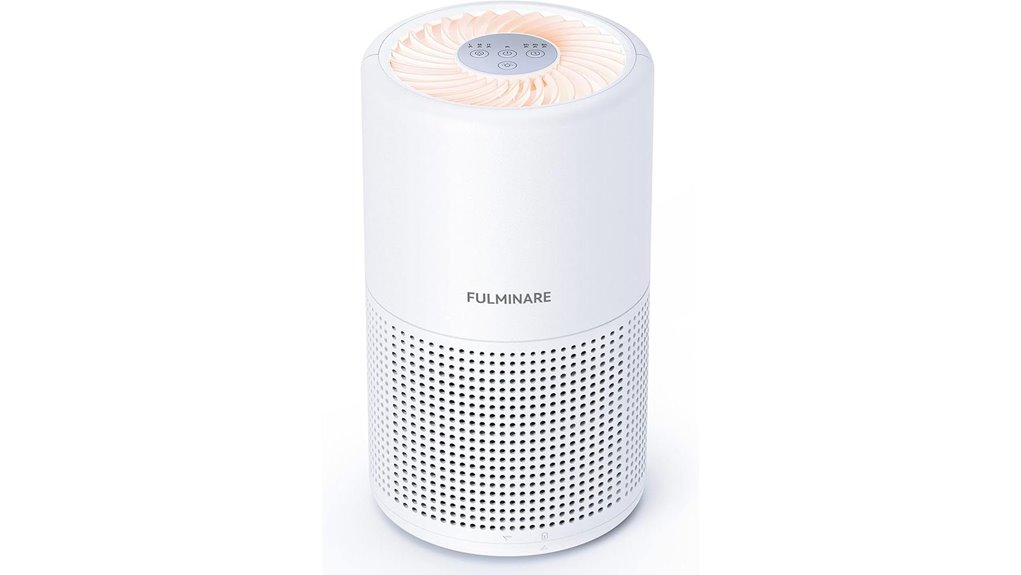
If you’re shopping for a bedroom purifier that doubles as a night light, the FULMINARE H13 HEPA Air Purifier stands out. This compact unit uses an H13 True HEPA filter to efficiently remove particles, keeping your space clean and peaceful. With dual-channel architecture and a 360° outlet, it refreshes air up to 5x per hour in rooms up to 215 ft². It runs quietly—about 24 dB on night mode—so light sleepers won’t be disturbed. It also serves as a night light. Set a timer (2–12 hours) and replace filters roughly every 3 months for ongoing performance.
Best For: Those seeking a compact bedroom purifier that also functions as a soft night light, ideal for light sleepers and families in small-to-medium spaces.
Pros:
- Quiet operation with night mode around 24 dB, suitable for bedrooms and nurseries
- Dual-function design combines air purification with a built-in night light
- Effective coverage for rooms up to 215 ft² (20 m²) with 360° 360° air intake/outlet
Cons:
- Replacement filters recommended about every 3 months, which adds ongoing cost
- May be compact for larger rooms beyond 215 ft², requiring multiple units
- Setup requires removing filter packaging and access to bottom base area, which may be mildly inconvenient during initial use
LEVOIT Core Mini-P Air Purifier with Filters
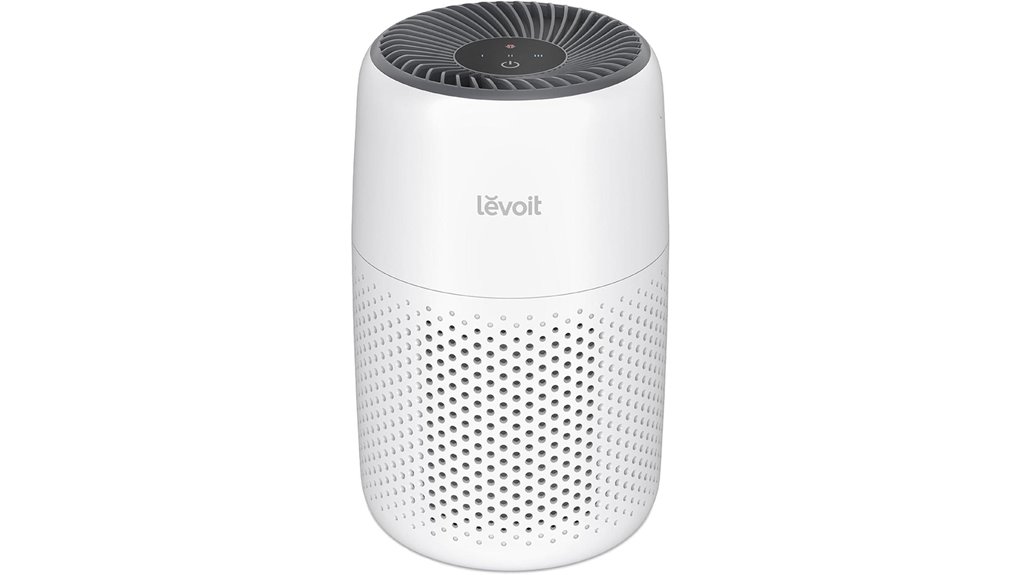
Looking for a compact purifier that fits on a desk or nightstand? The LEVOIT Core Mini-P Air Purifier with Filters targets smoke, allergens, pet dander, odor, and dust, ideal for bedrooms, offices, or dorms. It uses a 3‑in‑1 filter system with a pre-filter and main filter plus an activated carbon stage to neutralize odors. Genuine Levoit filters are recommended for best performance. This model supports aroma therapy, auto-off display, and sleep mode for quieter operation, with noise from 27 to 45 dB. Manufactured in Vietnam or China, it’s built to fit small spaces and daily use. Includes 100–240V power compatibility and compact dimensions.
Best For: Looking for a compact, desk- or nightstand-sized purifier that targets smoke, allergens, pet dander, odors, and dust in small to medium spaces like bedrooms, dorms, and offices.
Pros:
- Compact, space-saving design ideal for desks, nightstands, and small rooms.
- 3-in-1 filtration with pre-filter, main filter, and activated carbon stage to reduce odors and pollutants.
- Aroma pad support and sleep mode with quiet operation (27–45 dB).
Cons:
- May require genuine Levoit filters (Core Mini-RF) for optimal performance; using off-brand filters could be inconsistent.
- Manufactured in multiple countries (Vietnam/China) which may affect supply consistency or model variations.
- Limited room size coverage—best for small spaces; not as powerful for larger rooms.
Afloia Air Purifier for Large Rooms with Filter
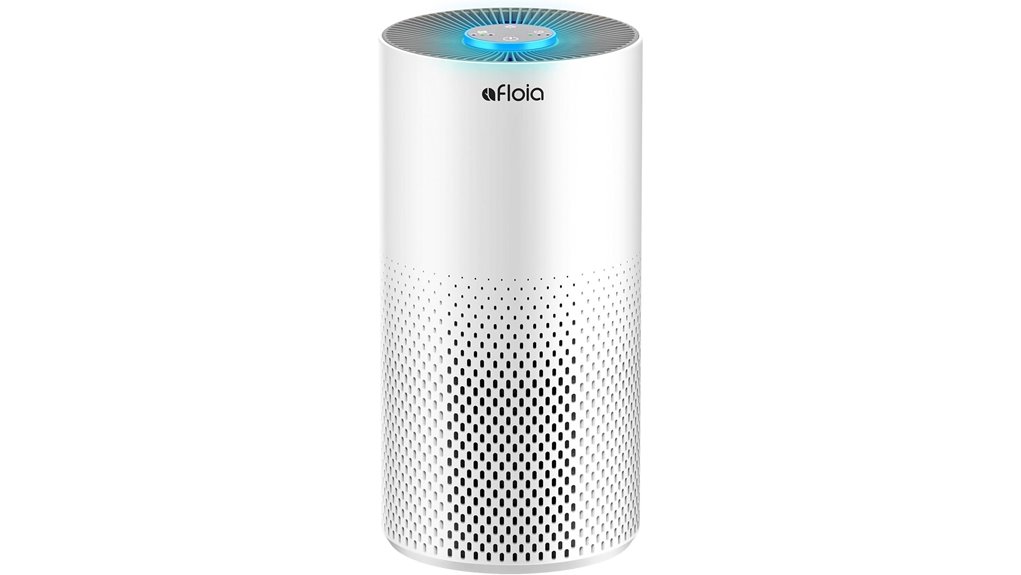
The Afloia Air Purifier is ideal for large rooms up to 1,076 sq ft, delivering quick purification with up to four air changes per hour in spaces around 269 sq ft and total purification in a single hour for larger layouts, making it a strong pick if you need powerful filtration without constant swapping. You’ll get a 3-stage filtration targeting pet dander, dust, pollen, smoke, mold, and odors, plus quiet operation with a 22 dB sleep mode and a 7-color auto-dimming night light. Controls include 2, 4, or 8-hour timers, adjustable speeds, and easy maintenance. White, 8D x 8W x 15H, 4.8 lb.
Best For: Homeowners with large living spaces who want powerful, low-noise air purification and customizable filtration and lighting features.
Pros:
- Powerful filtration capable of handling large rooms up to 1,076 sq ft with multiple air changes per hour
- Quiet operation (22 dB sleep mode) and 7-color auto-dimming night light
- Flexible controls including 2, 4, or 8-hour timers and adjustable fan speeds
Cons:
- Filtration replacement every 4–6 months may add ongoing cost
- Some users may find maintenance and filter options (Original, Pet Allergy, Antibacterial) require attention to match needs
- Large footprint and weight (8D x 8W x 15H, 4.8 lb) may be less ideal for compact spaces
LEVOIT 3-in-1 Air Purifier with HEPA Core 200S
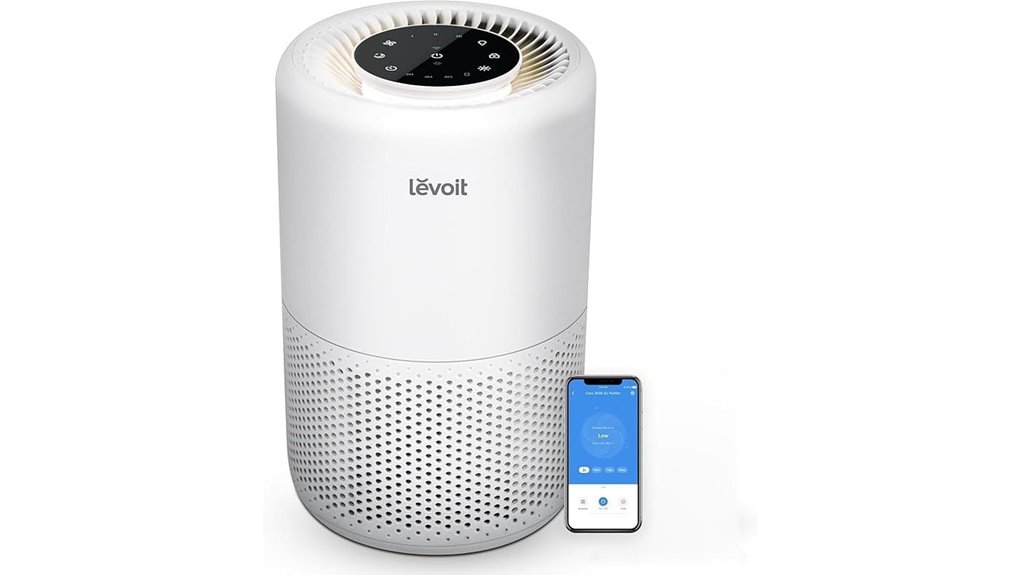
The LEVOIT 3-in-1 Air Purifier with HEPA Core 200S stands out for rooms up to 140 ft² with a 4.8x per-hour refresh rate, making it an ideal pick if you need fast, reliable air quality improvements in bedrooms or small living spaces. It’s AHAM VERIFIDE certified, meaning independent testing confirms performance and energy efficiency. Use genuine replacement filters and rely on the in-app filter life monitor to track upkeep. With 360° intake and a compact design, it cleans efficiently, removing 99.97% of 0.1–0.3 micron particles. Noise dips to 27 dB, and VeSync enables remote or voice control.
Best For: Those seeking a quiet, compact 140 ft² air purifier with smart controls and AHAM VERIFIDE-certified performance for bedrooms, nurseries, or small offices.
Pros:
- 360° intake and compact design for efficient cleansing in small spaces
- AHAM VERIFIDE certification confirms tested performance and energy efficiency
- Quiet operation as low as 27 dB with Display Off option and VeSync voice/app control
Cons:
- Suitable primarily for rooms up to 140 ft²; larger spaces may require multiple units
- Main filter replacement cost and the need for genuine filters for best performance
- May rely on app/voice control for full feature experience, which requires setup and connectivity
KNKA Air Purifier for Large Rooms (1,695 Ft²)
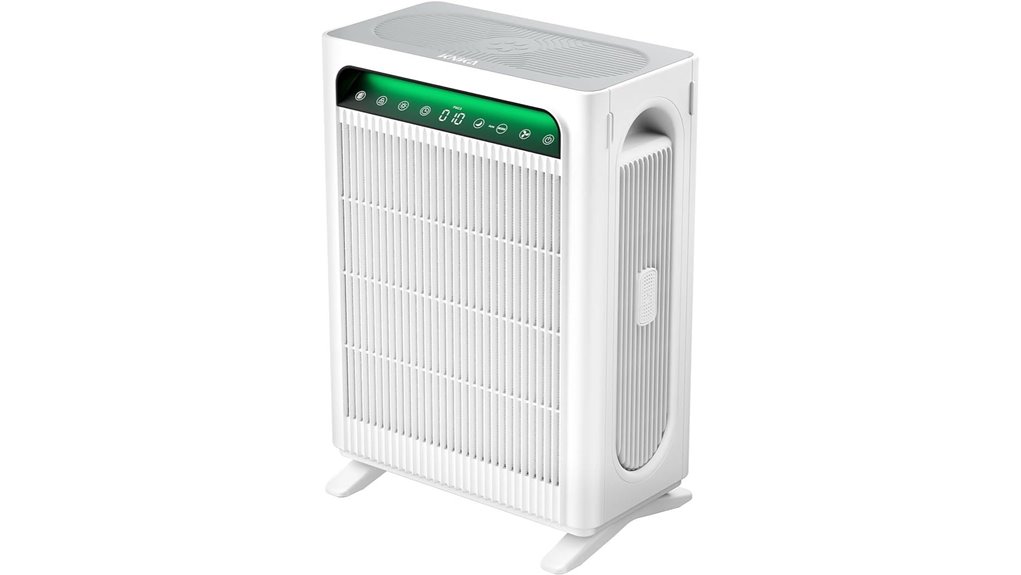
If you need to refresh air across a large living space, the KNKA Air Purifier for Large Rooms (1,695 Ft²) stands out with its dual-intake, dual-outlet design and powerful 3-stage filtration that combines a washable pre-filter, True HEPA, and activated carbon filters. It delivers strong CADR: 226 CFM for smoke, dust, and PM2.5, plus 244 CFM for pollen, supporting up to 1 full air refresh per hour in 1,695 ft². Dual front-and-back intakes and dual side outlets optimize airflow. Modes include PET, ECO, Sleep, and Auto with four speeds. Real-time AQI, filter indicators, and 3–6 month replacement intervals complete the package. Only genuine KNKA filters ensure peak performance.
Best For: Homeowners with large living spaces who want strong CADR performance, real-time air quality monitoring, and flexible modes for pet hair, odors, and energy-efficient operation.
Pros:
- High CADR ratings (226 CFM for smoke/dust/PM2.5; 244 CFM for pollen) and up to 1 full air refresh per hour in 1,695 ft².
- Dual intake and dual outlet design with a 3-stage filtration (washable pre-filter, True HEPA, activated carbon) for comprehensive filtration.
- Real-time AQI display, filter indicators, four fan speeds, and multiple modes (PET, ECO, Sleep, Auto) for personalized comfort and performance.
Cons:
- Filtration replacement recommended every 3–6 months, which may add ongoing cost and upkeep.
- Requires using genuine KNKA filters (specific SKUs) to ensure peak performance.
- Performance efficiency drops in larger spaces (~45% in larger spaces), meaning less dramatic air refresh than in smaller rooms.
MEGAWISE H13 HEPA Air Purifier: Quiet Filtration
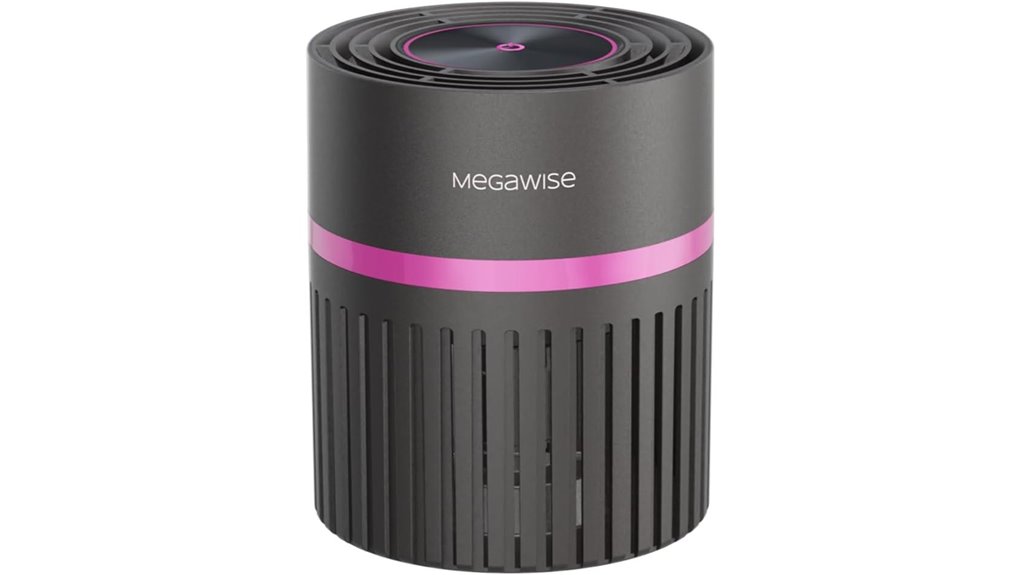
If you need a quiet, energy-efficient purifier that fits neatly on a nightstand or desk, the MEGAWISE H13 HEPA Air Purifier stands out with its true 99.97% filtration and near-silent operation. You get a compact, space-saving design that suits bedrooms, dorms, or home offices, with a neutral, modern look. It uses a 3-stage filtration to tackle cigarette smoke, dust, and pet dander, all handled by a true HEPA filter at 0.3 microns. Operated by a simple button, it draws only 8 watts and stays around 24–32 dB, depending on mode, with ongoing 24/7 support and warranty.
Best For: Quiet, energy-efficient purification in small spaces like bedrooms, dorms, and home offices where a compact purifier is preferred.
Pros:
- True HEPA filtration captures 99.97% of particles at 0.3 microns
- Very low power usage (about 8 watts) and whisper-quiet operation (~24–32 dB)
- Compact, modern design that fits on nightstands, desks, or small desks
Cons:
- Small footprint may limit room-wide air circulation for larger spaces
- Reported noise levels vary (24 dB vs. 32 dB) depending on mode
- Only single-unit inclusion with no bundled accessories listed
Air Purifier for Home with Sleep Mode (White)
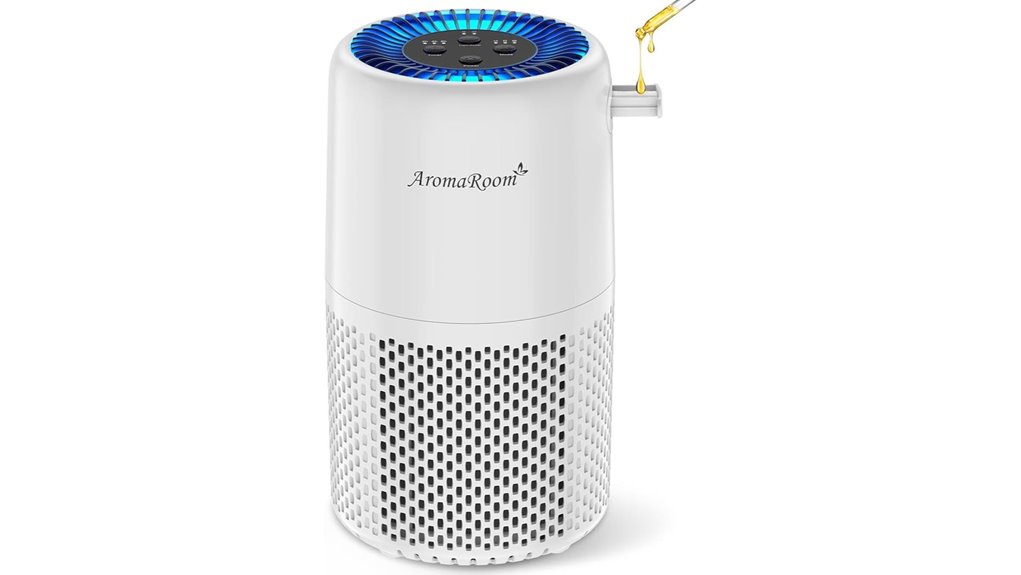
With Sleep Mode delivering about 22 dB on low settings, this Air Purifier for Home with Sleep Mode (White) is ideal if you want near-silent operation for bedrooms or baby rooms while still filtering pollutants. You get a 3-in-1 filter with Sleep Mode, quiet operation, and CADR of 32.4 CFM (55 m³/h), refreshing a ~123 ft² room about twice per hour. It captures ≥99.97% of tiny particles with an H13 HEPA filter. Use the aroma pad for optional oils, and rely on 2/4/8 hour timers. For care, replace the aroma filter every 3–6 months and keep it away from humid spaces. Local support available.
Best For: People seeking near-silent air purification in bedrooms, baby rooms, or spaces where quiet operation is a priority, with optional aroma feature and timer controls.
Pros:
- Very quiet operation: ~22 dB on low fan speeds, ideal for bedrooms and nurseries
- Effective filtration: H13 HEPA captures ≥99.97% of particles 0.1–0.3 µm; CADR 32.4 CFM (55 m³/h)
- Flexible features: 3-in-1 filter with Sleep Mode, aroma pad for essential oils, and 2/4/8 hour timers
Cons:
- Aroma oils require a separate fragrance pad (not included) and filter maintenance every 3–6 months
- Not ideal for high-humidity areas (avoid bathrooms or toilets)
- Moderate coverage: refreshing ~123 ft² (30 m²) about twice per hour; may be insufficient for larger rooms
Factors to Consider When Choosing Bedroom Purifier for Stale Air
When you pick a purifier, start with air filtration performance and the room size it can handle to ensure stale air gets cleaned effectively. Then check noise levels and any extra features that add real value without complicated maintenance. Finally, compare maintenance needs, filters, and overall cost to find a model that fits your bedroom and budget.
Air Filtration Performance
Air filtration performance hinges on how fast a purifier cleans your room and how well it handles stale air. You’ll want a true HEPA filter (like H13) that captures 99.97% of particles down to 0.1–0.3 microns, boosting overall bedroom air cleanliness. Look for a solid CADR, because higher CADR means quicker air refresh and more decisive stale-air reduction. A 360° air intake or outlet design helps draw air from multiple directions, yielding uniform filtration. Most setups use multi-stage filtration—pre-filter, HEPA, and activated carbon—to remove particles, odors, and fumes for thorough cleaning. Remember that real-world results depend on room size and purifier capacity, so match the unit to your target area to achieve effective air improvement.
Room Coverage Fit
How much space you’re trying to refresh should guide your purifier choice. Pick a unit whose stated room coverage matches or exceeds your room size so stale air gets refreshed effectively, for example a model rated for up to 215 ft² for small bedrooms or larger as needed. Make sure the CADR aligns with the room area to achieve multiple air changes per hour; a higher CADR means faster stale-air removal in the same space. Favor models with 360° air intake/outlet or dual-channel design to maximize uniform circulation and prevent stagnant corners. For continuous bedroom use, target purifiers that refresh the room 4–5 times per hour to dilute odors and particulates quickly. Check that the noise level stays near-silent (around 20–30 dB in sleep mode) to avoid disturbing sleep.
Noise Levels
To maintain uninterrupted slumber, prioritize purifier noise levels on their minimum setting, since the difference between 22 dB and 32 dB can be noticeable in a quiet bedroom. Most bedroom purifiers operate between 22 dB in sleep mode and around 45 dB at higher speeds, with many models aiming for ultra-quiet 22–27 dB operation. Look for explicit low-speed measurements, such as 22–24 dB, to ensure near-silent performance during rest. When comparing units, concentrate on the dB at the lowest setting, because small gaps—22 dB versus 32 dB—feel different in a quiet room. Also note factors beyond fan speed, like LED displays and auto-off lighting, which can affect perceived noise while you sleep.
Extra Features Value
When choosing a bedroom purifier for stale air, consider extra features that boost comfort without sacrificing quiet performance. Night lights, aroma pads, and sleep modes can raise comfort, but check how they affect noise; some units drop to 22–24 dB in sleep mode, keeping restful conditions intact. Auto-off timers (2–12 hours) let you run purifiers away from home to save energy while preserving stale-air cleanup. Aroma compatibility adds optional essential-oil diffusion, yet misuse can cause overflow or plastic damage—stick to recommended drops and avoid overfilling. App control and smart assistants (VeSync, Alexa, Google Assistant) enable remote operation, but may need setup and firmware updates. Real-time indicators (AQI, color lights) offer instant feedback to adjust speed or run time as needed.
Maintenance Requirements
Maintenance matters for stale-air purifiers because a well-maintained unit keeps filtration effective and quiet. To maintain performance, replace filters regularly; typical intervals are around every 3 months, with some models needing 4–6 months depending on usage and environment. Use only genuine replacement filters recommended for your unit to ensure proper fit and performance. Check for a built-in filter life monitor or replacement indicator so you know when to change. Remove protective packaging from new filters before installation to ensure proper airflow and filtration. Some units offer reminders or auto-restarts after filter changes and may have separate fragrances or aroma pads that require different maintenance timing. Following these cues helps your purifier sustain efficiency and minimize noise over time.
Common Questions
Do Purifiers Remove Stale Odors Effectively at Night?
Yes, purifiers can remove stale odors at night, especially models with activated carbon filters. You’ll notice fresher air as the device runs in auto or night modes with quieter fans. Change filters regularly, seal gaps, and keep humidity balanced to prevent odors from lingering. While heavy cooking or pets may linger, a good purifier with carbon and proper cadence will reduce smells without disturbing your sleep.
Which Purifier Is Best for Low-Energy Sleep Mode?
For low-energy sleep mode, choose a purifier with a true HEPA filter and an Energy Star rating, plus a whisper-quiet low fan setting. You’ll want features like auto or night mode, soft dim lights, and a sealed motor to reduce standby power. Avoid models with aggressive “boost” cycles that spike energy use. You’ll notice cleaner air and cooler sleep, especially if you run it on the lowest effective setting overnight.
How Often Must I Replace Filters for Stale Air?
You’ll need to replace filters every 6 to 12 months, depending on usage and air quality. If you smoke, have pets, or live in a high-pollution area, replace closer to 6 months; otherwise, aim for around a year. Check the device’s indicator and follow manufacturer guidance. Don’t ignore odors or decreased airflow—timely changes keep stale air out and freshness in, ensuring your purifier works at peak efficiency. Regular maintenance saves money and improves sleep.
Can Purifiers Improve Air Quality After Smoke Exposure?
Yes, purifiers can improve air quality after smoke exposure. They remove particulates, odors, and some gases, helping you breathe easier. Choose a unit with a true HEPA filter for particulates and an activated carbon filter for odors and gases. Run it continuously, seal gaps, and ventilate when possible. Check the CADR ratings for smoke, match to room size, and replace filters per manufacturer guidance to maintain effectiveness. Stay mindful of lingering indoor fumes.
Do Purifiers Emit Ozone or Ozone-Safeguards?
At the door of clarity, you learn that purifiers don’t emit ozone by design; they either filter it out or don’t produce it at all. You avoid ozone-generating devices and seek “ozone-safeguard” labels. You’ll choose units with ACH, HEPA filters, and proper certifications, keeping ozone well below safety thresholds. You trust reputable brands, replace filters regularly, and monitor room use. You act, you breathe easier, you’re guarded by clean air that stands quietly like a trusted sentinel.
All Together
In the hush of your night, you’ll hear a subtle, unseen chorus cleaning the air—like echoes of a bygone library, steady as a lighthouse. These purifiers act as silent sentinels, turning stale into fresh with every breath. Choose one that fits your space, your sleep, and your rhythm. When you wake, you’ll notice the difference, and you’ll wonder how you ever slept without it. Consider this your quiet invitation to breathe easier.